The EmpCo Directive and the New EU FAQ: Which Green Claims Stay Allowed
The EmpCo Directive and the updated European Commission FAQ define which green marketing claims have been allowed since 27 September 2026 and which are banned. Concrete examples, deadlines, and a practical checklist.
- The EmpCo Directive (EU) 2024/825 has applied since 27 September 2026 (in Germany via the amended UWG, Federal Law Gazette 2026 I No. 43). It bans greenwashing across the entire B2C space, from packaging to your website.
- The European Commission published a FAQ on it (first edition November 2025, updated in May and again in September 2026, now also available in German). It is not legally binding, yet courts and authorities use it to interpret the directive.
- Generic environmental claims such as "environmentally friendly", "climate neutral", or "green" are banned without proof. Offset-based climate neutrality claims are banned per se.
- Still allowed are specific, substantiated claims about one clearly named aspect, plus forward-looking targets backed by an implementation plan and independent verification.
- There is no statutory transition period; for old stock, the FAQ calls for proportionate enforcement. Reviewing your claims now avoids warnings and costly recalls. Our communication check is a good place to start.
Since 27 September 2026, new rules have governed how companies in the EU may advertise sustainability. The EmpCo Directive (Directive (EU) 2024/825 on empowering consumers for the green transition) draws clear lines between permitted and misleading environmental claims. Because many phrases in the directive left room for interpretation, the European Commission added a detailed FAQ and updated it in May and September 2026. The September 2026 version is also available in a German translation for the first time.
This article summarises which green marketing claims hold up under EmpCo and the new FAQ, which ones are illegal, and how to adjust your sustainability communication. With concrete examples of allowed and prohibited wording.
What is the EmpCo Directive?
For a broad overview, see our article EmpCo Directive: everything you need to know now. This post focuses on marketing claims.
The EmpCo Directive (short for "Empowering Consumers for the Green Transition") amends two existing EU consumer laws: the Unfair Commercial Practices Directive (UCPD) and the Consumer Rights Directive. Its goal is to protect consumers from greenwashing and premature obsolescence and to give them better information on durability and reparability.
At its core sits an expanded blacklist of prohibited commercial practices in Annex I of the UCPD. Practices on this list are banned without a case-by-case assessment, meaning they are unlawful in all circumstances.
The key deadlines at a glance:
| Date | Event |
|---|---|
| 6 March 2024 | Published in the EU Official Journal |
| 26 March 2024 | Directive enters into force |
| November 2025 / 18 May 2026 | Commission's first FAQ and update |
| 19 February 2026 | German implementing act (Third Act Amending the UWG) promulgated, Federal Law Gazette 2026 I No. 43 |
| 27 March 2026 | Deadline to transpose into national law |
| September 2026 | Updated Commission FAQ, now also in German |
| 27 September 2026 | Binding application for companies |
Important: there is no statutory transition period. Since 27 September 2026, every new advert and every product description has to comply, and online claims must be adjusted immediately. For old stock such as already printed packaging, the Commission (FAQ, September 2026 version, question 18) and the joint position of the consumer protection authorities (CPC, 30 June 2026) call for proportionate enforcement, for example via stickers or notices at the point of sale. In Germany, the Bundestag adopted a corresponding provision (Section 15b UWG) on 24 September 2026; Bundesrat approval is still pending. There is therefore no fixed sell-off period.
Why the new EU FAQ matters
The directive text sets out principles, but leaves many practical questions open. That is exactly where the Commission's FAQ comes in. It explains how terms such as "generic environmental claim" or "recognised excellent environmental performance" should be understood, and gives examples.
Two things are worth knowing:
The FAQ expressly reflects only the "preliminary views" of the Commission. Only the Court of Justice of the EU can interpret the directive with binding force. In practice, however, courts and enforcement authorities lean heavily on such FAQs, so you should treat this one as interpretive guidance.
The updated version from 18 May 2026 sharpened three areas in particular: brand and company names, the requirements for sustainability labels, and the treatment of visual elements. The September 2026 version also addresses old stock (question 18) and clarifies that CSRD sustainability reports generally do not fall under EmpCo, whereas consumer advertising that reuses content from them does (question 1). More on those below.
Which claims are prohibited
The following practices are banned under EmpCo without a case-by-case assessment. Using them since 27 September 2026 risks competition-law warnings and regulatory penalties.
1. Generic environmental claims without proof
Generic environmental claims without concrete substantiation on the same medium are banned. This covers terms such as "environmentally friendly", "green", "climate friendly", "eco", "biodegradable", or "nature conscious" when they stand on their own.
The reason: such terms suggest a broad ecological benefit that a single product can rarely demonstrate.
2. Climate neutrality based on offsetting
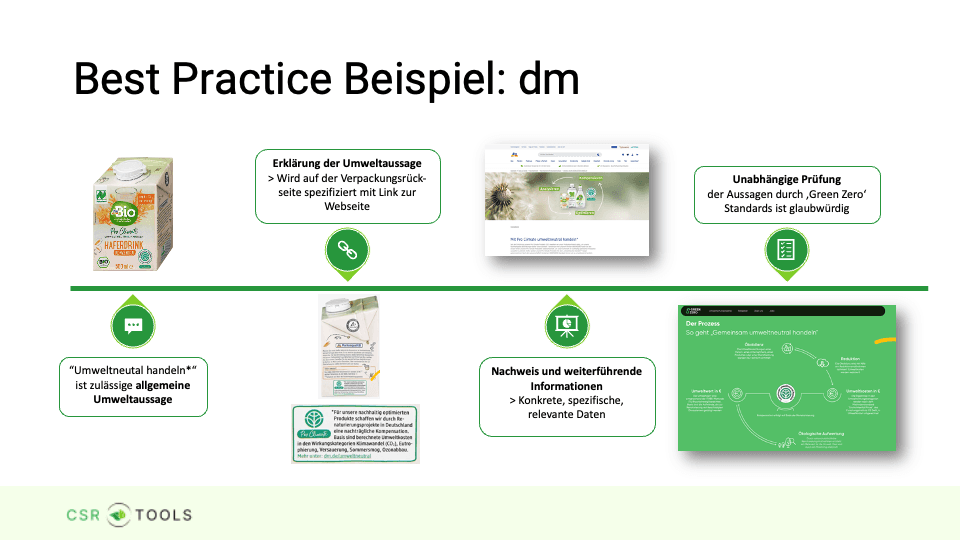
Claims that a product is "climate neutral", "CO₂ neutral", or "climate positive" because emissions are offset by buying credits outside the company's own value chain are banned per se, even if the offsetting is explained transparently. Phrases like "climate neutral shipping" fall under this too, as long as they rest on pure offsetting.
3. Self-created sustainability labels
Your own logos, badges, or graphics that look like a certification mark but do not rest on a certified scheme with independent verification are prohibited. A sustainability label has to either come from a public authority or be based on a certification scheme with transparent, publicly accessible criteria.
4. Whole-product claims based on a single aspect
Inferring a benefit for the whole product from one feature is prohibited. Example: "made from recycled material" when only the packaging is recycled and the product itself is not.
5. Unsubstantiated future promises
Forward-looking environmental claims such as "climate neutral by 2030" without a clear, publicly accessible implementation plan with measurable targets and independent monitoring are not allowed.
6. Unsubstantiated durability and reparability claims
Statements like "especially durable" or "easy to repair" without a factual basis are banned. It is also prohibited to present the statutory legal guarantee as a distinctive selling point.

Which claims stay allowed
The EmpCo Directive does not ban advertising with sustainability. It requires claims to be specific, true, and provable. These forms remain viable:
- Specific claims about one clearly named aspect. Example: "The packaging consists of 90% recycled PET." or "100% of production energy comes from renewable sources."
- Future targets with substance. "Climate neutral by 2030" is allowed if a detailed, publicly available implementation plan with interim targets exists and an independent third party checks progress regularly.
- Transparent statements about investments without a neutrality framing. Example: "We finance a reforestation project in Kenya", kept separate from the actual product claim.
- Recognised labels such as the EU Ecolabel or Type I ecolabels under EN ISO 14024.
The exception: recognised excellent environmental performance
According to the FAQ, generic terms like "environmentally friendly" may exceptionally be used without full specification if the product demonstrates a recognised excellent environmental performance. The Commission names three routes:
The product carries the official EU Ecolabel under Regulation (EC) No 66/2010.
It meets a national or regional Type I ecolabelling scheme under EN ISO 14024.
The third route is proof of top performance under applicable EU law. Important per the FAQ: a lack of space on the packaging is no justification for shortening the required specification.
Allowed or prohibited: examples side by side
| Prohibited (generic) | Allowed (specific and substantiated) |
|---|---|
| "Environmentally friendly product" | "Packaging made from 90% recycled PET" |
| "Climate neutral" (via offsetting) | "Produced with 100% renewable electricity at our Berlin site" |
| "Made from recycled material" (packaging only) | "Packaging from recycled material, product from virgin material" |
| "Climate neutral by 2030" (no plan) | "Climate neutral by 2030, per a verified implementation plan" |
| Own "eco" logo without verification | EU Ecolabel or Type I ecolabel |
What the updated FAQ versions additionally clarify
Brand and company names
A name containing "green", "eco", or "blue" is not automatically an environmental claim. What matters is whether a reasonably well-informed and observant consumer expects an environmental benefit in the given context. New: company names now expressly fall within scope.
CSRD reports and advertising
According to the FAQ (September 2026 version, question 1), sustainability reports under the CSRD generally do not fall under EmpCo. However, if consumer advertising picks up content from the report, such as climate targets or reduction results, those marketing claims are subject to the EmpCo rules.
Old stock
There is no statutory transition period. According to the FAQ (question 18) and the joint position of the consumer protection authorities (CPC, 30 June 2026), authorities should act proportionately with goods already produced, for example where companies cover problematic claims with stickers or correct them at the point of sale. Online claims, by contrast, must be adjusted immediately. The German provision on proportionality for old stock (Section 15b UWG) was adopted by the Bundestag on 24 September 2026; the Bundesrat still has to approve it.
Visual elements
Purely visual elements such as colours or nature motifs without text do not, in themselves, constitute a generic environmental claim. Combined with text or a logo, however, green leaves, water drops, or nature symbols may count as an implicit environmental claim. The assessment is made case by case from the average consumer's perspective.
Sustainability labels
For certification-based labels, the scheme owner and the verifying body must be two legally separate entities. Verification should follow recognised standards, for example ISO 17065 or the procedures of Regulation (EC) No 765/2008.
What companies should do now
The rules already apply. If you have not yet reviewed and adjusted your claims systematically, do it now. There is now a tool for each of these steps, and we compare them in our overview of EmpCo tools. These steps help:
- Build an inventory of all environmental claims: packaging, website, social media, catalogues, and company and product names.
- Match every claim to evidence. Where proof is missing, the claim has to be made specific or removed.
- Remove offset-based climate neutrality claims and replace them with transparent statements about actual reductions.
- Review labels and logos: are they based on independent certification? Replace self-created badges.
- Secure future targets: document the implementation plan and organise independent verification.
Review your green marketing claims for EmpCo compliance in a structured way and spot risks before they become a problem. For more background, see our page on sustainability communication.
Frequently asked questions about the EmpCo Directive and the EU FAQ
Since when has the EmpCo Directive applied?
Directive (EU) 2024/825 entered into force on 26 March 2024. Member States had to transpose it into national law by 27 March 2026; Germany did so through the Third Act Amending the UWG (Federal Law Gazette 2026 I No. 43). It has been binding for companies since 27 September 2026. There is no statutory transition period. For old stock, the Commission and authorities call for proportionate enforcement (e.g. stickers); online claims must be adjusted immediately.
Is the European Commission's FAQ legally binding?
No. The FAQ expressly reflects only the Commission's preliminary views and is not legally binding. Only the Court of Justice of the EU can interpret the directive with binding force. In practice, courts and authorities regularly use such FAQs for interpretation, so companies should take them seriously.
Can I still advertise with 'climate neutral'?
Only if the claim does not rest on offsetting outside your own value chain. A climate neutrality claim achieved by buying carbon credits is prohibited per se, even with a transparent explanation. Specific, substantiated statements about actual emission reductions in your own operations or supply chain remain permitted.
Are terms like 'green' or 'eco' allowed in a brand name?
Such a name is not automatically a prohibited environmental claim. What matters is whether an average consumer expects an environmental benefit in the given context. If so, the name must meet the requirements for generic environmental claims. Since the May 2026 update, this expressly applies to company names too.
What is a 'recognised excellent environmental performance'?
It exceptionally allows generic terms to be used without full specification. It can be demonstrated through the EU Ecolabel, through a Type I ecolabel under EN ISO 14024, or through documented top performance under applicable EU law.
Does the directive also apply to small companies?
Yes. EmpCo covers all commercial practices in the B2C space, regardless of company size. Unlike the CSRD, it does not depend on thresholds for turnover or headcount. Every environmental claim aimed at consumers falls within scope.
Conclusion
The EmpCo Directive ends the era of vague green advertising. Whoever communicates specifically and honestly, backing every claim with evidence, stays on the right side of the line. Banned are generic promises, offset-based climate neutrality, and self-made labels. The Commission's FAQ offers valuable orientation, even though it is not legally binding.
Companies that inventory and substantiate their claims now turn an obligation into a trust advantage. Credible sustainability communication becomes a competitive factor.
Sources and further reading
- Directive (EU) 2024/825 in the EU Official Journal
- Third Act Amending the UWG (Federal Law Gazette 2026 I No. 43, German)
- European Commission: Sustainable consumption (including the FAQ, September 2026 version)
- European Commission FAQ on the EmpCo Directive (PDF)
- Sustainability communication overview: from obligation to opportunity