Materiality Assessment for Insurers: Benchmark of 42 Insurance Groups
Which ESRS topics are material for insurers? Our benchmark of 42 European insurance groups (Allianz, AXA, Generali, Zurich and more) shows core topics, outliers and insurance-specific IROs.
- We analysed the materiality assessments of 42 European insurance groups for financial year 2025, 22 of them from Germany, Austria and Switzerland (DACH).
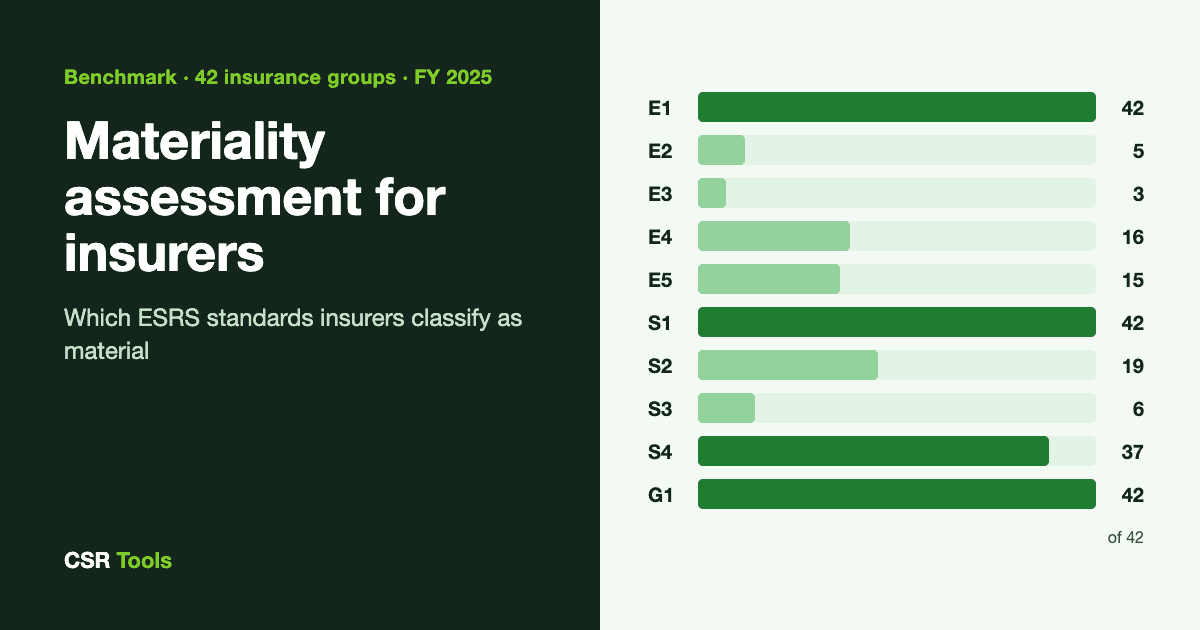
- E1 Climate change, S1 Own workforce and G1 Business conduct are material for all 42 insurers, S4 Consumers and end-users for 37 (88 %). Among primary insurers it is 34 out of 35.
- Eleven groups report exactly these four standards and nothing else, including Talanx, HUK-COBURG, Signal Iduna, Zurich and Aegon. The median is five material standards per insurer.
- The variation lies in E4 Biodiversity (38 %), E5 Circular economy (36 %) and S2 Workers in the value chain (45 %). It depends on the business model and the screening method, not on size.
- What makes insurers different arises in the portfolio: insurance-associated emissions, nat cat risk, the protection gap, data protection and cyber.
- Under the simplified ESRS (Delegated Regulation 2026/1563, mandatory from financial year 2027) the topic list is only a point of orientation. A sector benchmark therefore becomes the starting list of the assessment.
Which sustainability topics are material for an insurer? The question comes up every year, at the latest when the auditor compares the materiality assessment with the competition. General benchmarks such as the DRSC survey of the DAX 40 only help so far, because for insurers impacts, risks and opportunities (IROs) arise in a different place than in industry: in investments and in underwriting, not in the office building.
That is why we analysed the sustainability statements of 42 European insurance groups for financial year 2025, from Allianz and Munich Re through HUK-COBURG, R+V and Debeka to AXA, Generali and NN. This article shows which ESRS standards insurers classify as material, where they differ and what you can take from this for your own assessment. The analysis reflects the status as of 12 October 2026.
1. Which ESRS topics are material for insurers?
The result has two tiers. Four standards are practically always material, all others only for some insurers.
- E1 Climate change
- 42 · 100 %2220
- E2 Pollution
- 5 · 12 %3
- E3 Water and marine resources
- 3 · 7 %
- E4 Biodiversity and ecosystems
- 16 · 38 %79
- E5 Resource use and circular economy
- 15 · 36 %69
- S1 Own workforce
- 42 · 100 %2220
- S2 Workers in the value chain
- 19 · 45 %712
- S3 Affected communities
- 6 · 14 %33
- S4 Consumers and end-users
- 37 · 88 %1918
- G1 Business conduct
- 42 · 100 %2220
| ESRS standard | All (n = 42) | DACH (n = 22) | Rest of Europe (n = 20) |
|---|---|---|---|
| E1 Climate change | 42 (100 %) | 22 (100 %) | 20 (100 %) |
| E2 Pollution | 5 (12 %) | 2 (9 %) | 3 (15 %) |
| E3 Water and marine resources | 3 (7 %) | 1 (5 %) | 2 (10 %) |
| E4 Biodiversity and ecosystems | 16 (38 %) | 7 (32 %) | 9 (45 %) |
| E5 Resource use and circular economy | 15 (36 %) | 6 (27 %) | 9 (45 %) |
| S1 Own workforce | 42 (100 %) | 22 (100 %) | 20 (100 %) |
| S2 Workers in the value chain | 19 (45 %) | 7 (32 %) | 12 (60 %) |
| S3 Affected communities | 6 (14 %) | 3 (14 %) | 3 (15 %) |
| S4 Consumers and end-users | 37 (88 %) | 19 (86 %) | 18 (90 %) |
| G1 Business conduct | 42 (100 %) | 22 (100 %) | 20 (100 %) |
| Average material standards per group | 5.4 (median 5) | 5.0 (median 5) | 5.8 (median 5) |
The core: E1, S1, S4 and G1. 37 of the 42 groups classify all four standards as material. S4 is missing only for the three reinsurers (Munich Re, Hannover Re, SCOR) and for Swiss Life and Länsförsäkringar. Swiss Life lists insurance and advice only as supplementary, non-material information. Länsförsäkringar rates S4 as "important but not material" and reports data protection as an entity-specific topic.
The most common pattern is the pure core. Eleven groups report exactly E1, S1, S4 and G1: Talanx, Nürnberger, Alte Leipziger-Hallesche, Signal Iduna, HUK-COBURG, SV SparkassenVersicherung, Vienna Insurance Group, Zurich, Aegon, Ageas and Storebrand. The core plus E5 and the core plus S2 follow four times each, the core plus E4 three times.
With 3 to 10 material standards, the median is 5. This matches the EFRAG State of Play 2025: financial institutions classify 5 standards as material on average, non-financial companies 6. At the top are Allianz (all 10), AXA and CNP Assurances (9 each). Hannover Re and Swiss Life report the narrowest scope (3 each).
DACH insurers report slightly more narrowly. They average 5.0 standards compared with 5.8 in the rest of Europe, and eight of the 22 DACH groups stick to the pure core. The largest gaps are in S2, E5 and E4. The groups are small, however: just two or three companies shift the percentage by ten points. We read this as a tendency, not as a country effect.
2. The peer matrix: all 42 insurers at a glance
The table shows, for each insurance group, which ESRS standards it classifies as material in its 2025 sustainability statement. ● = material, – = not material. Type: P = primary insurer, R = reinsurer, B = bancassurance/conglomerate.
| Company | Country | Type | E1 | E2 | E3 | E4 | E5 | S1 | S2 | S3 | S4 | G1 | Σ | Source |
|---|---|---|---|---|---|---|---|---|---|---|---|---|---|---|
| Allianz | DE | P | ● | ● | ● | ● | ● | ● | ● | ● | ● | ● | 10 | Report |
| Munich Re | DE | R | ● | – | – | ● | – | ● | ● | ● | – | ● | 6 | Report |
| Hannover Re | DE | R | ● | – | – | – | – | ● | – | – | – | ● | 3 | Report |
| Talanx | DE | P | ● | – | – | – | – | ● | – | – | ● | ● | 4 | Report |
| BarmeniaGothaer | DE | P | ● | – | – | ● | – | ● | – | – | ● | ● | 5 | Report |
| Nürnberger | DE | P | ● | – | – | – | – | ● | – | – | ● | ● | 4 | Report |
| W&W | DE | B | ● | – | – | – | ● | ● | – | – | ● | ● | 5 | Report |
| Alte Leipziger-Hallesche | DE | P | ● | – | – | – | – | ● | – | – | ● | ● | 4 | Report |
| LVM | DE | P | ● | – | – | – | – | ● | ● | – | ● | ● | 5 | Report |
| VHV | DE | P | ● | – | – | – | – | ● | – | ● | ● | ● | 5 | Report |
| R+V | DE | P | ● | – | – | ● | ● | ● | ● | – | ● | ● | 7 | Report |
| Signal Iduna | DE | P | ● | – | – | – | – | ● | – | – | ● | ● | 4 | Report |
| Debeka | DE | P | ● | – | – | – | – | ● | ● | – | ● | ● | 5 | Report |
| HUK-COBURG | DE | P | ● | – | – | – | – | ● | – | – | ● | ● | 4 | Report |
| Provinzial | DE | P | ● | – | – | – | ● | ● | – | – | ● | ● | 5 | Report |
| Versicherungskammer Bayern | DE | P | ● | ● | – | ● | ● | ● | ● | – | ● | ● | 8 | Report |
| SV SparkassenVersicherung | DE | P | ● | – | – | – | – | ● | – | – | ● | ● | 4 | Report |
| UNIQA | AT | P | ● | – | – | ● | – | ● | ● | – | ● | ● | 6 | Report |
| Vienna Insurance Group | AT | P | ● | – | – | – | – | ● | – | – | ● | ● | 4 | Report |
| Zurich | CH | P | ● | – | – | – | – | ● | – | – | ● | ● | 4 | Report |
| Swiss Life | CH | P | ● | – | – | – | – | ● | – | – | – | ● | 3 | Report |
| Helvetia Baloise | CH | P | ● | – | – | ● | ● | ● | – | – | ● | ● | 6 | Report |
| AXA | FR | P | ● | ● | ● | ● | ● | ● | ● | – | ● | ● | 9 | Report |
| SCOR | FR | R | ● | – | – | ● | – | ● | ● | – | – | ● | 5 | Report |
| CNP Assurances | FR | P | ● | ● | ● | ● | ● | ● | ● | – | ● | ● | 9 | Report |
| Covéa | FR | P | ● | – | – | ● | ● | ● | ● | ● | ● | ● | 8 | Report |
| Groupama | FR | P | ● | – | – | – | – | ● | ● | – | ● | ● | 5 | Report |
| Crédit Agricole Assurances | FR | P | ● | – | – | – | ● | ● | – | – | ● | ● | 5 | Report |
| NN Group | NL | P | ● | – | – | ● | – | ● | ● | – | ● | ● | 6 | Report |
| Aegon | NL | P | ● | – | – | – | – | ● | – | – | ● | ● | 4 | Report |
| a.s.r. | NL | P | ● | – | – | ● | ● | ● | ● | ● | ● | ● | 8 | Report |
| Achmea | NL | P | ● | ● | – | ● | ● | ● | ● | – | ● | ● | 8 | Report |
| Ageas | BE | P | ● | – | – | – | – | ● | – | – | ● | ● | 4 | Report |
| Sampo | FI | P | ● | – | – | – | ● | ● | ● | – | ● | ● | 6 | Report |
| Tryg | DK | P | ● | – | – | – | ● | ● | – | – | ● | ● | 5 | Report |
| Storebrand | NO | B | ● | – | – | – | – | ● | – | – | ● | ● | 4 | Report |
| Gjensidige | NO | P | ● | – | – | – | ● | ● | ● | – | ● | ● | 6 | Report |
| Länsförsäkringar AB | SE | B | ● | – | – | – | – | ● | ● | – | – | ● | 4 | Report |
| Generali | IT | P | ● | – | – | ● | – | ● | – | – | ● | ● | 5 | Report |
| Mapfre | ES | P | ● | – | – | – | – | ● | ● | – | ● | ● | 5 | Report |
| Unipol | IT | P | ● | – | – | ● | – | ● | – | – | ● | ● | 5 | Report |
| PZU (FY 2024) | PL | B | ● | – | – | – | – | ● | – | ● | ● | ● | 5 | Report |
The basis is the sustainability statements or non-financial statements for financial year 2025, published in spring and summer 2026 (PZU: 2024, because the 2025 report was not available). We only included groups whose materiality assessment is structured by ESRS or mapped to the ESRS by the company itself. Not included are Swiss Re and Die Mobiliar (own topic lists), UK insurers without ESRS reporting and subsidiaries that only report via their parent (e.g. ERGO, Generali Deutschland, Gothaer). "Material" means the standard is material at standard level, whether through impacts, risks or opportunities and whether reported in full or only in short form. Some classifications rely on our interpretation, for example where a company does not explicitly name its non-material standards.
3. What other studies show on materiality for insurers
So far there is no large, insurance-only statistic across all ten standards. The best basis for comparison are the CSRD benchmarks by PwC Germany, an analysis by the German Actuarial Association (DAV) and figures for the whole financial sector from DRSC/Deloitte.
| Standard | Our benchmark 2025 (42 insurers) | PwC 2025 (20 insurers) | PwC 2024 (27 insurers) | DRSC/Deloitte 2024 (9 financial companies) |
|---|---|---|---|---|
| E1 | 100 % | 100 % | 100 % | 100 % |
| E2 | 12 % | "clearly secondary" | approx. 20 % | 33 % |
| E3 | 7 % | "clearly secondary" | approx. 20 % | 22 % |
| E4 | 38 % | approx. 33 % | approx. one third | 44 % |
| E5 | 36 % | "clearly secondary" | approx. 20 % | 22 % |
| S1 | 100 % | 100 % | 100 % | 100 % |
| S2 | 45 % | – | more than half | 44 % |
| S3 | 14 % | – | – | 22 % |
| S4 | 88 % | approx. 80 % | all primary insurers | 78 % |
| G1 | 100 % | 100 % | 100 % | 100 % |
Sources: PwC, 20 May 2026 (the 100 % for E1, S1 and G1 refer to all financial institutions analysed), PwC, 18 Nov 2025, DRSC/Deloitte, Nov 2025, DAV, 19 Dec 2025.
All sources agree on the core: E1, S1 and G1 are material for practically all insurers, S4 for around 80 %. The fact that this is not 100 % is due to the reinsurers in the samples. Two differences stand out:
- E5 is material more often in our benchmark (36 % compared with around 20 % at PwC). The difference comes from the large property and casualty insurers. Sampo, Tryg and Gjensidige justify E5 with resource use in claims handling, AXA, Covéa, Crédit Agricole Assurances, a.s.r. and R+V with "repair instead of replace".
- E2 and E3 are material less often (12 % and 7 %). The higher DRSC/Deloitte figures include banks and are of limited use as an insurance benchmark.
The second reporting year also brought substantial consolidation. According to PwC, the median number of IROs among insurers fell from 35 to 32, the median report shrank from 108 to 91 pages, and 80 % of insurers changed their methodology. R+V went from 67 to 49 IROs, Mapfre from 53 to 31. But the movement goes both ways: Groupama and LVM dropped E4 and E5 respectively, UNIQA added E4 and Covéa added S3.
4. Insurance-specific topics: materiality arises in the portfolio
Almost all insurers structure their assessment into three areas: own operations, investments and underwriting. Own operations yield almost only S1 and G1. Everything that sets insurers apart from other sectors comes from the two portfolios.
E1 Climate change: a portfolio topic
Climate change mitigation and adaptation are practically always included. On the sub-topic of energy, approaches differ: most German insurers include it, while several European groups have dropped it. Generali explicitly states that climate is "not material" for its own operations, and NN no longer classifies its own Scope 1 and 2 emissions as material. This fits the orders of magnitude: for the median insurer, 0.7 % of emissions are Scope 1 and 2, and 99.6 % of Scope 3 are financed emissions (PwC).
Climate risks split by business line: physical risk (storms, floods, nat cat) lies mainly in underwriting, transition risk mainly in investments.
Insurance-associated emissions: almost always material, rarely measured
The clearest insurance-specific topic is the emissions from underwriting (insurance-associated emissions, IAE). For 2024, 93 % of 27 insurers classified them as material, but only six calculated them under PCAF Part C, mostly only for personal motor business. In our benchmark, at least 17 of the 42 groups name a climate impact from underwriting. Allianz, BarmeniaGothaer, HUK-COBURG, LVM and W&W even report it as an entity-specific disclosure, because ESRS E1 does not explicitly cover these emissions.
Anyone who classifies IAE as material is effectively committing to a PCAF Part C measurement that most insurers cannot yet deliver. For the basics of Scope 3 and its categories, see our article Scope 3 and its role in GHG accounting.
S4 and G1: data protection, quality of advice and corruption
Under S4, information-related impacts are the most common sub-topic: data protection, quality of advice and mis-selling. They are followed by personal safety, such as health protection in health and life insurance, and social inclusion, meaning access to insurance and closing the protection gap. Generali and Unipol list demographic change as a separate sub-topic, AXA "inclusive insurance", UNIQA the "(financial) health of customers".
Under G1, corruption and bribery is included almost universally, followed by corporate culture and whistleblower protection. Payment practices, on the other hand, are more often explicitly excluded, for example by UNIQA, Generali and CNP.
Entity-specific topics recur
Around two thirds of insurers additionally report entity-specific IROs. In our benchmark, five topics come up again and again:
- Cyber and data protection: Munich Re, Hannover Re, Talanx, Swiss Life, AXA, SCOR, Crédit Agricole Assurances, Storebrand, Länsförsäkringar and PZU.
- Financial crime and insurance fraud: Storebrand, Länsförsäkringar, Crédit Agricole Assurances and Gjensidige.
- AI and digitalisation: SCOR, Gjensidige, VIG, Unipol and Signal Iduna.
- Distribution network: Provinzial ("management of sales partners"), Unipol (agency network) and SV ("strength of the Sparkasse brand").
- Customer satisfaction: Munich Re and Allianz (Net Promoter Score).
In practice this means: an insurer without its own cyber or data protection topic should be able to explain where this topic is covered in S1, S4 or G1.
Our Excel template guides you step by step through the double materiality assessment under the revised ESRS and automatically creates your materiality matrix.
5. Where insurers diverge: E4, E5, S2 and S3
Each of the four contested standards follows its own logic. For your assessment, this logic matters more than the percentage.
E4 Biodiversity (16 of 42) depends on the screening method. Those who screen at sector level with the WWF Biodiversity Risk Filter, UNEP FI tools or ENCORE often conclude "not material", for example Hannover Re and Talanx. Those who assess the pressures from investee companies or policyholders tend to conclude "material", such as AXA, CNP, Covéa, NN, Generali, Unipol and UNIQA. Groupama, by contrast, considers itself "unable" to measure nature materiality reliably and has dropped E4 again. More on the standard itself in our ESRS E4 practical guide.
E5 Circular economy (15 of 42) depends on claims handling. Where there is a large motor and property claims business, material use in repair and replacement becomes an impact in the value chain. This creates the opportunity "repair instead of replace". Whether the threshold is reached is a genuine judgement call: LVM dropped E5 for 2025 because repair options are rarely used. There are also other drivers, such as property development at W&W or hospitals at Helvetia Baloise.
S2 (19 of 42) has two routes. The first runs through investments: human rights risks at investee companies, as at AXA, SCOR, NN, Groupama, Mapfre, UNIQA and Versicherungskammer Bayern. The second runs through service providers and distribution: the workers of claims service providers (Sampo, Gjensidige, Covéa) or, as at LVM, tied agents and their agency staff.
S3 (6 of 42) becomes material mainly through philanthropy. VHV justifies S3 with the VHV Foundation, Covéa with patronage and volunteering, a.s.r. with a financial self-reliance programme. Only at Allianz and Munich Re does S3 arise from impacts in the portfolio. Whether donations and foundations fit "affected communities" is open to challenge.
6. Checklist: materiality assessment for insurers
The benchmark yields clear rules. The first concerns the core, the others depend on the business model.
- Evidence the core, don't just assert it: E1, S1, S4 and G1 are the sector standard for primary insurers. Excluding one of them requires a strong, documented rationale. Conversely, a result of exactly these four standards is no sign of negligence, as long as the remaining standards have been assessed in a traceable way.
- Large motor and property claims business: seriously assess E5 (repair instead of replace) and S2 (claims service providers).
- Large portfolio of corporate bonds and equities: assess E4 and S2 via investee companies and disclose which screening tool covers which sectors.
- Health insurers financing care: assess E2 and E5 via the healthcare they finance.
- Reinsurers: S4 is typically not material.
- Exclusive agents or agency network: assess S2 or an entity-specific distribution topic.
- S3: only justify with a genuine portfolio or site impact, not with donations or a foundation alone.
- Fixed items on the topic list: insurance-associated emissions, nat cat risk and protection gap, data protection and cyber, financial crime, responsible investment and, increasingly, AI.
Good templates for well-documented rationales are Hannover Re and Talanx, which justify each environmental standard individually with a named screening tool, and BarmeniaGothaer, which argues separately for own operations, investments and underwriting. Pre-formulated impacts, risks and opportunities for all ESRS topics are available in our IRO database.
7. What changes for insurers in 2026 and 2027
The revised ESRS were published in the Official Journal on 21 September 2026 as Delegated Regulation (EU) 2026/1563. They are mandatory for financial years starting on or after 1 January 2027 and may be applied voluntarily for 2026. For the materiality assessment, these are the main changes (details in our article on the final ESRS and VS standard 2026):
- A top-down approach is permitted, and the topic list in ESRS 1 only serves as orientation.
- An information filter applies to all disclosures, and policies, actions and targets may be reported at topic level.
- A justification of non-materiality is only mandatory for E1.
- Anyone who manages investments on a fiduciary basis without bearing the risks and rewards of ownership does not have to assess them. It remains open whether unit-linked policies fall under this.
For insurers this means: without a binding topic list, a properly derived peer comparison like this one becomes the starting list of the assessment. Sector frameworks are useful as a long list, for example SASB FN-IN, the new GRI 18 sector standard for insurance (adopted in September 2026, effective from 2027) and the S&P Global CSA weights. There will be no sector-specific ESRS for insurers after the Omnibus. On the financial side, EIOPA expects insurers to align their materiality assessment with their Solvency II risk management and ORSA.
At the same time, the circle of mandatory reporters is shrinking. After the Omnibus, the CSRD only applies to companies with more than 1,000 employees and more than €450 million in net turnover. EIOPA expects most insurance undertakings to no longer report under the ESRS on a mandatory basis. Our benchmark consists mainly of large groups. For smaller mutuals and regional insurers it therefore shows the upper limit of what the market expects.
Conclusion: the core is predictable, the rationale makes the difference
Which standards an insurer should classify as material is almost 90 % predictable: E1, S1, S4 and G1. The real work lies at the margins, with E4, E5 and S2. Here the business model and the screening method decide, and a "material" or "not material" is only worth as much as the documented rationale behind it. Anyone already reporting voluntarily under the new ESRS for 2026 should clean up weakly justified marginal standards now rather than carry them along for another year.
Materiality Master is our AI-powered software for the double materiality assessment: get IRO suggestions, assess them together and create your materiality matrix automatically.
Frequently asked questions on materiality assessments for insurers
Which ESRS topics are material for insurers?
In our benchmark of 42 European insurance groups, E1 Climate change, S1 Own workforce and G1 Business conduct are material for all of them, S4 Consumers and end-users for 88 %. They are followed by S2 Workers in the value chain (45 %), E4 Biodiversity (38 %) and E5 Circular economy (36 %). E2, E3 and S3 are material for only a few insurers.
How many ESRS standards are material for insurers on average?
On average 5.4, with a median of 5. The range runs from 3 (Hannover Re, Swiss Life) to 10 (Allianz). Eleven of the 42 groups report exactly the four core standards E1, S1, S4 and G1. Insurers in Germany, Austria and Switzerland report slightly more narrowly, with 5.0 standards compared with 5.8 in the rest of Europe.
Why is S4 usually not material for reinsurers?
Reinsurers have no end customers; they insure other insurers. Topics such as quality of advice, data protection for retail customers or access to insurance therefore hardly affect them. In our benchmark, none of the three reinsurers (Munich Re, Hannover Re, SCOR) classifies S4 as material, while 34 of 35 primary insurers do.
What are insurance-associated emissions?
Insurance-associated emissions (IAE) are the greenhouse gas emissions of insured clients that are attributed to an insurer proportionally via its premiums, for example from motor or commercial lines. The method for this is PCAF Part C. Almost all insurers classify IAE as material, but only a few have measured them so far.
Do insurers still need a materiality assessment after the Omnibus?
It is mandatory only for insurers within the scope of the CSRD, i.e. from financial year 2027 those with more than 1,000 employees and more than €450 million in net turnover. EIOPA expects most insurance undertakings to fall out of scope as a result. Many will still need an assessment, because rating agencies, investors and Solvency II risk management ask about material sustainability topics.