Green Controlling: What Role Controllers Play for the CSRD
Green Controlling combines sustainability and management. Learn how controlling and ESG teams jointly implement CSRD requirements.
- Green Controlling integrates sustainability goals into traditional corporate management, making ESG measurable and steerable.
- Controllers take on a new role under the CSRD: they link financial and non-financial data, assess sustainability risks, and anchor ESG KPIs in planning.
- Sustainability managers need controlling as a strategic ally, not just a data supplier.
- Five practical steps help ESG officers actively shape the interface with controlling.
- Early involvement of controlling improves audit-readiness and the robustness of sustainability reporting.
"Green Controlling": Buzzword or key to successful CSRD implementation?
Anyone who truly wants to embed sustainability in their company must also make it controllable. And this is where controlling comes in: It provides the data, methods, and systems to turn ESG goals into concrete control parameters.
For many ESG managers, this means: The path to an effective sustainability report is not just about content, but also about figures, processes, and IT systems. Controllers are not adversaries, but strategic allies if involved early.
What exactly is "Green Controlling"?
The term "Green Controlling" describes the systematic integration of ecological and social goals into traditional corporate management. It goes beyond environmental costs or CO2 balances. It is about the holistic linkage of sustainability and economic control logic.
The concept was coined years ago by the Green Controlling Expert Group of the International Controller Association (ICV). With the Corporate Sustainability Reporting Directive (CSRD) and the European Sustainability Reporting Standards (ESRS), it gains entirely new relevance. While sustainability and finance were often managed separately in the past, the CSRD now demands the exact opposite: an interlinked management and reporting world.
Specifically, Green Controlling means:
- Making sustainability goals measurable
- Integrating non-financial key figures (ESG KPIs) into planning, forecasts, and investment calculations
- Considering ESG risks and opportunities in risk management
In other words: controlling provides the figures and structures so that sustainability is not just a communication tool that looks good on the website, but can be strategically managed and also withstands a CSRD audit by third parties.
What is the role of controllers in the CSRD context?
For many controllers, the CSRD means an expansion of their previous role. Their classic tasks, such as analyzing plan deviations, controlling budgets, and evaluating investments, are now supplemented by new questions:
- Which ESG key figures do we need to collect to meet ESRS requirements?
- How can financial and non-financial goals be managed jointly?
- How do we assess sustainability risks from a financial perspective (outside-in)?
- How do we measure our impact on the environment and society (inside-out)?
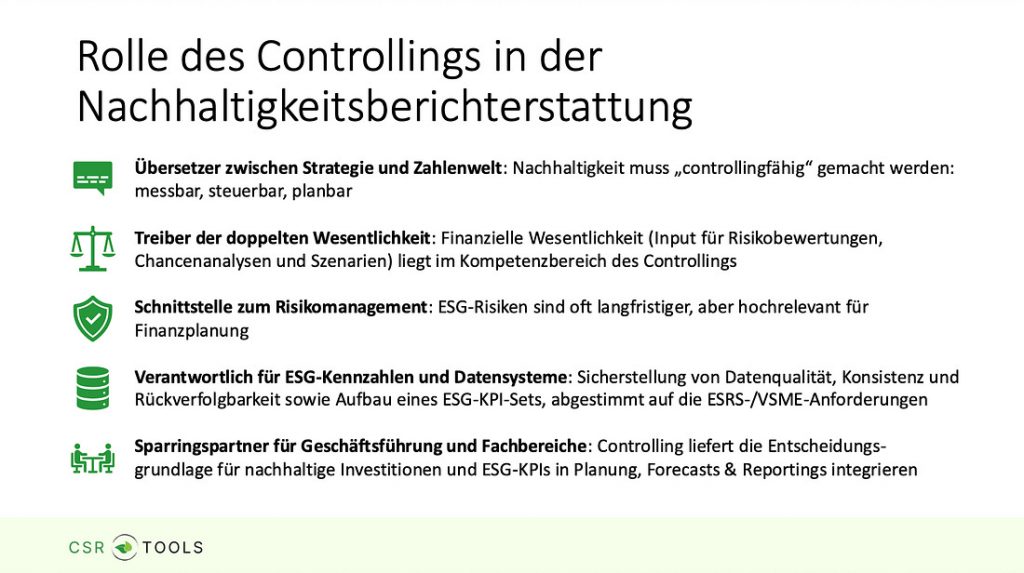
What are the new Green Controlling tasks?
What are the challenges for controllers in implementing the CSRD?
| Challenge | Description |
|---|---|
| Data Availability and Quality | Missing or incomplete ESG data and heterogeneous data sources |
| Quantification of ESG Aspects | Difficulty translating non-financial metrics (e.g., human rights, biodiversity, climate risks) into economic impacts |
| Integration into Existing Control Logic | Challenges in linking ESG data with traditional financially focused planning, control, and reporting systems |
| Competence and Role Clarification | Unclear responsibilities between controlling, sustainability management, and risk management; lack of know-how |
| Time Horizons and Perspectives | Sustainability topics require long-term planning horizons, while traditional management targets annual or quarterly results |
| Regulatory Complexity | Constant evolution of regulatory requirements |
| Systemic and Technical Requirements | Missing IT systems for automated ESG data collection; high degree of manual effort and Excel-based interim solutions |
| Auditability and Assurance | Challenge of ensuring reliable documentation and traceability of data and methods |
What does this mean for sustainability managers?
For sustainability officers, Green Controlling primarily means one thing: Another important stakeholder should be involved in the work.
Sustainability management has been a cross-functional management task not just since the CSRD. However, due to reporting obligations, sustainability managers can no longer reach their goals safely without the controlling team.
Controllers in many companies are gatekeepers for planning, budget, key figures, and systems. If you want to put your sustainability goals into practice, you need to ensure they are compatible with their logic. This means:
- Sustainability goals need a financial-logical translation to be integrated into control processes
- ESG key figures must be prepared so they fit into existing reporting and planning systems
- Risks and opportunities from the Materiality Assessment must be integrated into financial risk assessment through close collaboration
You need controllers as allies, not as "data service providers" or retrospective auditors.
What should ESG officers do now?
Here are five practical steps you, as a sustainability manager, can take immediately to actively shape Green Controlling:
- Clarify Roles and Create Interfaces: Who in the company is responsible for which ESG data? Who calculates them? Who "owns" them in the report? Which data interfaces already exist and where are they missing?
- Involve Controlling in the DMA: Controllers can evaluate IROs (financial opportunities, risks, and scenarios) and set up the process in an auditable and robust manner. They should be involved early, especially in the double Materiality Assessment.
- Develop a Common KPI Logic: Target systems and time horizons (e.g., embedding climate goals in 5-year plans) should be aligned with controlling. Defining a common set of ESG KPIs that are both auditable and controllable is advisable.
- Establish a Common Understanding of Goals: Think of sustainability as an integral part of financial management.
- Institutionalize Collaboration: Regular exchange (e.g., a quarterly ESG steering committee with controlling, sustainability, risk) provides a platform for ongoing communication.
Start your double materiality assessment with a structured Excel template. Designed for CSRD and ESRS requirements, it helps controlling and ESG teams work from the same data.
Interested in a Green Controlling presentation?
Our CEO Alexander Spahn conducted a workshop at the International Controller Association (ICV) in September 2025 on the "Role of Controllers in Sustainability Reporting". Would you like to receive the presentation?
Comment "Green Controlling" on his LinkedIn post and he will send you the presentation for free.
Conclusion: Green Controlling Makes Sustainability Controllable
The CSRD demands more transparency and greater controllability. This is precisely where the interface between sustainability and controlling emerges. This is where Green Controlling originates.
For sustainability managers, this means: those who involve controllers early, link ESG goals with corporate planning, and develop a common KPI logic have significantly better chances for effective and robust sustainability reporting.
Controlling is not the "number tamer of yesterday," but the enabler of sustainable transformation. Many corporate leaders expect ESG to be a business case. The Chief Sustainability Officer is the one who initiates and actively shapes this collaboration.
Frequently asked questions about Green Controlling and the CSRD
What is Green Controlling?
Green Controlling is the systematic integration of sustainability goals into traditional corporate management. It links ecological and social objectives with financial control logic, making ESG targets measurable and manageable within existing planning and reporting systems.
Why do controllers matter for CSRD compliance?
The CSRD requires companies to report both financial and non-financial data in an integrated, auditable way. Controllers are the gatekeepers of planning systems, budgets, and KPI structures. Without their involvement, ESG goals remain disconnected from corporate steering and cannot withstand external audit.
How should sustainability managers involve controlling in the double materiality assessment?
Involve controllers early in the double materiality assessment. They can evaluate financial IROs (impacts, risks, and opportunities), set up the process in an auditable manner, and ensure the results feed into planning and risk management systems. A shared materiality analysis template helps both teams work from the same data.
What is the biggest practical challenge in combining sustainability and controlling?
The biggest challenge is usually data quality and integration. ESG data often comes from fragmented, manual sources that do not connect to existing financial systems. Building clear data ownership, standardized KPI definitions, and automated collection processes is the critical first step.