Why the Chief Sustainability Officer is Now a Game-Changer
Chief Sustainability Officer: How CSOs leverage ESG to increase enterprise value, secure growth, and build competitive advantages.
- Companies with a Chief Sustainability Officer (CSO) perform significantly better in ESG ratings. The depth of the mandate matters, not just the title.
- The role is shifting from compliance-oriented reporter to strategic architect who integrates ESG into strategy, finance, and innovation.
- With increasing ESG maturity, responsibility moves to business units, but the CSO remains indispensable as a central enabler.
- Successful CSOs combine sustainability expertise with business know-how and have direct access to the board.
- Studies show a positive correlation between CSO presence and corporate success, though causality is not established.
In recent years, sustainability has evolved from a side note to a central component of corporate strategies. Regulatory requirements like the CSRD, increasing expectations from investors and customers, and pressure from employees make ESG a topic that determines future viability and competitive position.
In this dynamic, one role is gaining massive importance: that of the Chief Sustainability Officer (CSO). The study by the consulting firm Strategy& impressively shows that companies with a strong CSO perform significantly better in ESG ratings. Nevertheless, the role often remains underestimated or positioned organizationally in a way that prevents it from unfolding its full potential.
Key Findings on the Role of the Chief Sustainability Officer from the Study
The Strategy& study examined 1,640 publicly listed companies with insightful results:
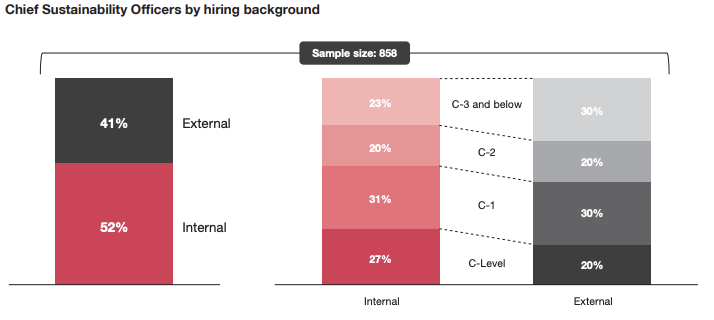
- More CSOs than ever before: In 2020/21 alone, as many CSOs were appointed as in the eight years prior combined. Overall, approximately 80% of companies have a more or less formal Chief Sustainability Officer.
- Better ESG Performance: 98% of companies with top sustainability ratings (A at Refinitiv) had a CSO or comparable function.
- But many "light" roles: Just under half of CSOs operate without real influence. Often two or more hierarchical levels below the executive board and no access to the board or supervisory board.
- Industry Differences: Consumer goods and chemical companies more frequently rely on formal CSOs, while in engineering or e-commerce the rate is very low.
This shows: The title alone is not enough. The mandate and organizational embedding are crucial.
How is the Role of the Chief Sustainability Officer Changing?
The short answer: From compliance manager to strategic architect. Previously, sustainability was often located in the areas of CSR, HSE, or communications, with a focus on reputation protection, risk avoidance, and reporting. Today, stakeholders expect significantly more:
- Strategy Linkage: The sustainability strategy must be linked to the corporate strategy, and ESG goals should be embedded.
- Financial Relevance: ESG metrics are incorporated into pricing, investment decisions, and risk management (e.g., via climate risk analysis or double Materiality Assessment).
- Innovation Driver: Sustainability opens up new markets and business opportunities.
This moves the Chief Sustainability Manager from a supporting role to the center of the business model. Successful CSOs are architects of change, not only reporters. They understand the complexity of ESG, prioritize, and translate it into concrete business cases.
Where Does the CSO Stand in the Governance and Operating Model of the Future?
At the beginning of an ESG journey, central sustainability teams are important: They consolidate expertise, ensure compliance, and drive awareness. However, the more mature an organization becomes, the more sustainability responsibility shifts to the specialized and business units. Once the initial quick wins are exhausted, further development requires deep expertise and proximity to operational business. That is why many companies are gradually shifting responsibility for implementation to the individual business units.
- Finance integrates ESG risks into KPIs and reporting.
- HR develops sustainable work models and purpose-driven employer brands.
- Procurement drives supply chain transparency and Scope 3 emissions.
- Sales and Marketing credibly position sustainable products in the market.

Sustainability is like digitalization: It affects everyone.
At the same time, a central sustainability unit remains relevant. It provides strategic direction, sets common standards, orchestrates sustainability reporting and data management, and looks beyond the obvious. Precisely because operational units are heavily utilized in day-to-day business, they often lack the capacity to identify trends, risks, and opportunities early on.
The Chief Sustainability Officer remains the link: a strategic enabler with a direct line to the executive board, who holds the overall architecture together and prepares the company for new trends and risks early on.
What Must a Modern Chief Sustainability Officer Bring to the Table?
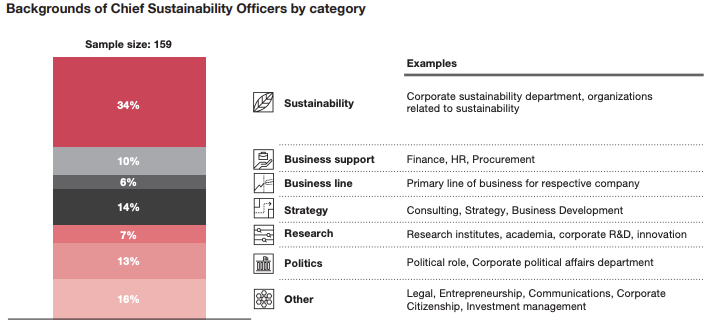
The study shows that the most successful top sustainability officers combine a mix of sustainability expertise and business know-how. Around one third come from classic sustainability departments, another 30% from strategy, consulting, or operational business units.
Crucial is the ability to build bridges: between technology and strategy, between reporting and innovation, between compliance and value creation.
Strategy& Study: Empowered Chief Sustainability Officers
5 Questions for your Chief Sustainability Officer
Use these questions to assess the maturity level of your own ESG governance. They quickly show whether the CSO is taking on a true transformational role or remaining in a supporting role.
- Board Connection: Does sustainability have direct access to corporate leadership?
- Integration: In which processes is ESG already embedded, and where are there gaps?
- Value Creation: Can you clearly articulate how sustainability strengthens your business model?
- Stakeholder Competence: Are investors, customers, employees, and regulators systematically involved?
- Skill Set: Does the team have the right combination of expertise and entrepreneurial experience?
A structured double materiality assessment is the foundation of any strong ESG strategy. Our Excel template guides you through the process step by step.
Are Companies with a Chief Sustainability Officer more Successful?
That investing in ESG is a business case for companies has already been proven in several studies. But is a CSO a critical success factor? In her paper, as part of her master's thesis on the topic "Do chief sustainability officers impact firm value," Julia Winkelmann concludes:

The appointment of a Chief Sustainability Officer has a positive effect on firm value, but this is not statistically significant.
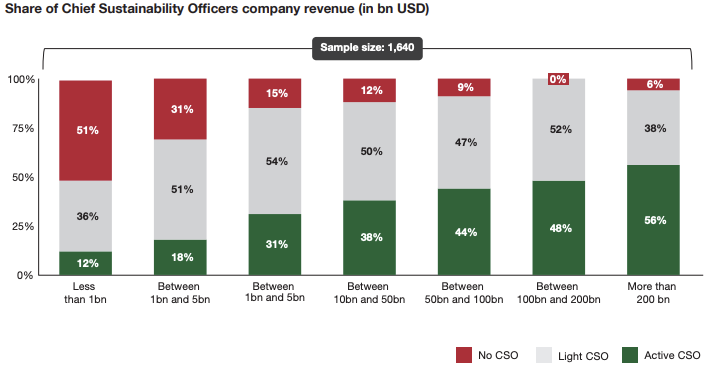
A look at the Strategy& study also shows a clear correlation between company size and the prevalence of CSO roles: The higher the revenue, the more frequently the position is filled. While in smaller companies (under $1 billion USD revenue) more than half manage entirely without a CSO, in the revenue class above $200 billion USD, more than half already have an active CSO role.
It is important to contextualize: These data show a correlation, not causation. It cannot be definitively said whether larger companies tend to appoint a CSO more often, or whether companies with strong sustainability leadership grow more successfully in the long term. What is certain: With increasing company size and complexity, the necessity to professionally manage sustainability at the highest level also increases.
Strategy& Study: Empowered Chief Sustainability Officers
Conclusion: the Chief Sustainability Officer as Key to Transformation
The role of the Chief Sustainability Officer exemplifies the change that ESG triggers in companies. Properly embedded, it can become a driver for innovation, resilience, and future viability. If mispositioned, it remains stuck in reporting (e.g., ESRS, GRI, or VSME) and squanders potential.
The VSME standard, originally designed for SMEs, is being broadened into the "VS (Voluntary Standard)" expected as a delegated act later in 2026. It will cover non-SMEs with fewer than 1,000 employees (or under 450m euro turnover) that fall outside the CSRD scope. CSRD-obligated companies may not require value-chain partners with 1,000 employees or fewer to provide information beyond this voluntary standard.
For companies, this means: Do not view the CSO as a mere formality, but as a strategic lever. Those who equip the role with a mandate, competencies, and clear governance not only gain trust from investors and customers but also strengthen their competitive position in the market long-term.
Frequently asked questions about the Chief Sustainability Officer
What does a Chief Sustainability Officer actually do?
A CSO leads a company's sustainability strategy and ESG activities. This includes managing sustainability reporting, overseeing the double materiality assessment, coordinating ESG data across business units, and representing sustainability topics at board level. The role varies widely depending on how much mandate the CSO actually holds.
Is a Chief Sustainability Officer legally required under the CSRD?
The CSRD does not mandate a CSO by name. It does require companies above the reporting thresholds to produce a comprehensive sustainability report, including governance disclosures. Many companies appoint a CSO to manage this process, but it is not a legal requirement as such. Under the revised thresholds in force since March 2026, only companies with more than 1,000 employees and more than 450m euro net turnover are within scope.
How can a CSO create real business value beyond compliance?
The biggest value comes from embedding sustainability into business decisions rather than running it as a separate reporting exercise. A well-positioned CSO links ESG metrics to financial planning, identifies risks early via tools like climate risk analysis, and helps unlock access to sustainable finance. This turns the sustainability function from a cost center into a strategic asset.
What skills should a strong Chief Sustainability Officer have?
The Strategy& study shows that successful CSOs combine sustainability expertise with genuine business acumen. Around a third come from classic sustainability backgrounds, while 30% come from strategy, consulting, or operational roles. Key capabilities include stakeholder management, data literacy, cross-functional communication, and the ability to translate ESG topics into concrete business cases.