- EMAS and ESRS share core requirements: annual reporting, stakeholder engagement, materiality assessment, and third-party audit.
- EMAS-certified companies already hold verified environmental data that maps directly onto ESRS E1-E5 disclosures.
- Gaps remain: ESRS requires more granular data (e.g. Scope 3 emissions) and covers social and governance topics that EMAS does not.
- You can integrate the EMAS environmental statement into your CSRD report in three different ways.
- Starting with EMAS is a practical head-start for CSRD compliance, but you will still need to add non-environmental disclosures.
The requirements for companies to prepare sustainability reports in accordance with the Corporate Sustainability Reporting Directive (CSRD) are very extensive. Those who do not act in time risk high costs and missed opportunities. At the same time, the Eco-Management and Audit Scheme (EMAS) provides a proven basis for environmental management and reporting. What many do not know: The synergies between EMAS and the European Sustainability Reporting Standards (ESRS) can help companies meet CSRD requirements efficiently and cost-effectively.
In this article, we show how you can use your existing EMAS structure to comply with the new reporting standards, saving time and resources while strengthening the credibility of your reports.
EMAS meets ESRS: a strong duo
The ESRS and the Eco-Management and Audit Scheme (EMAS) may appear different at first glance, but both share common goals: transparency and the improvement of companies' environmental performance. The combination of both frameworks offers an excellent opportunity to approach sustainability reporting efficiently and holistically.
Similarities between EMAS and ESRS
EMAS and the CSRD, which the ESRS prescribes as a reporting standard, require companies to report regularly. Both frameworks require this:
- Annual reports: Companies must document their progress in a structured and transparent report.
- Stakeholder engagement: Both EMAS and ESRS value stakeholder involvement, whether through open dialog or by taking their interests into account in strategic direction.
- Materiality assessment: Both systems require the identification and assessment of material environmental aspects as well as direct and indirect impacts. In addition to the impact perspective, the CSRD also considers the financial perspective in the so-called double materiality.
- Audit by third parties: Both systems require an independent audit. EMAS auditors fulfill the CSRD requirements for a limited audit.
Why EMAS is a strong partner for ESRS
- Focus on environmental management: EMAS focuses exclusively on the environment and provides a solid foundation for the environmental disclosures of the ESRS (E1-E5).
- Existing data and processes: Companies that are already EMAS-certified have verified data and established processes that can be directly integrated into ESRS reporting.
- Facilitation through synergies: EMAS organisations can use many of their existing disclosures, such as environmental policy, objectives and performance indicators, to meet the ESRS requirements.
Additional added value through EMAS
EMAS goes beyond mere reporting. It offers a continuous improvement approach through the integrated environmental management system. This dynamic combines well with the strategic objectives of the ESRS, for example in the definition of measures and targets in the areas of climate protection, resource use and biodiversity.
To summarise: EMAS and ESRS complement each other. Companies that have already implemented EMAS can meet the requirements of the CSRD more easily and cost-effectively.
Mapping: How EMAS supports ESRS reporting
The requirements for CSRD reporting are extensive and can be challenging. However, EMAS provides a valuable basis for meeting many of the ESRS requirements, particularly in the areas of environmental management and reporting.
How EMAS complements the CSRD report
EMAS and ESRS have numerous overlaps that can make CSRD compliance easier. The most important supporting aspects include:
- Environmental policies and targets: The EMAS environmental policy and the reporting on objectives and measures can be used directly for the disclosures in accordance with ESRS E1 to E5.
- KPIs: EMAS requires key performance indicators in areas such as energy consumption, emissions and resources. This data covers many of the indicators required in the ESRS and has already been validated.
- Materiality assessment: The EMAS requirements for assessing direct and indirect environmental impacts largely correspond to the ESRS impact materiality analysis.
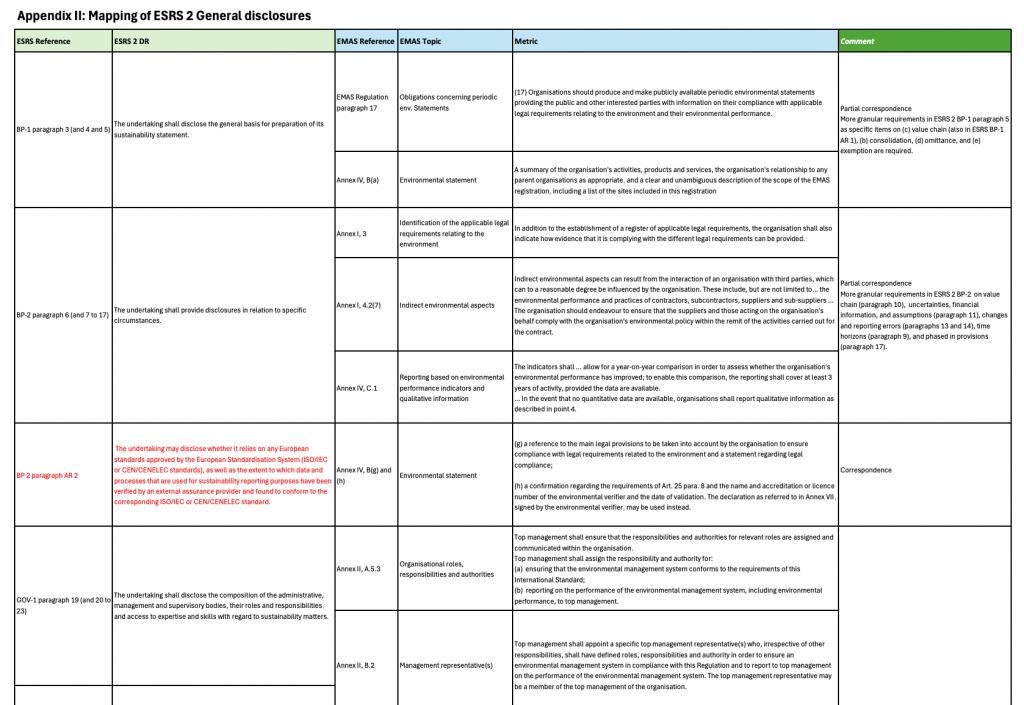
In addition to a mapping of the ESRS to EMAS, there is also a mapping of the CSRD requirements to the various ISO certifications. We also offer a clear presentation of other (free) CSRD aids such as the data point mapping tool.
Gaps and additions to EMAS and CSRD
Despite the numerous synergies, compliance with the ESRS standards requires additional information in some cases:
| Gap area | What EMAS covers | What ESRS adds |
|---|---|---|
| Data granularity | Core environmental KPIs (energy, emissions, resources) | More detailed data, e.g. Scope 3 emissions, financial impacts, biodiversity strategies |
| Scope | Environmental aspects only | Social and governance topics (S1-S4, G1) must also be disclosed |
Integration of the EMAS environmental statement into the ESRS
An EMAS environmental statement can be integrated into the CSRD report in three ways:
- ESRS first, then EMAS. You first create an ESRS-compliant sustainability statement, which is then used as the basis or draft for the EMAS environmental statement.
- Extended EMAS declaration. You create an EMAS environmental declaration that is supplemented with additional information from the ESRS (e.g. on climate and resource use). This extended EMAS declaration can then be integrated into the ESRS sustainability declaration by reference.
- A combined statement. You create a single ESRS-compliant statement that contains all relevant EMAS information. In this case, no separate EMAS environmental statement is published. Both requirements are combined in one report.
Practical advantages of mapping
- Time and resource savings: Companies can use their existing EMAS data and processes to significantly reduce the effort required for ESRS reporting.
- Integrated reporting: By combining the EMAS environmental statement with the ESRS requirements, duplication of work can be avoided.
- High credibility: The audited EMAS data provides a solid basis for the traceability and quality of the reports.
EMAS is therefore a decisive lever for meeting the complex requirements of the ESRS efficiently and cost-effectively, provided you already meet this standard. Companies that already use EMAS have a clear advantage in implementing the CSRD requirements.
A detailed mapping of the EMAS requirements to the ESRS can be found in the document "Understanding the synergies between ESRS and EMAS" published by EFRAG (Appendix I, p. 21).
Already using EMAS? The ESRS data points template helps you identify which disclosures you already cover and where you still need to fill gaps.
Conclusion
The combination of EMAS and ESRS offers companies a practical path to meeting the requirements of the CSRD efficiently and cost-effectively. EMAS provides a proven basis for environmental management and delivers validated data and established processes that can be directly incorporated into ESRS reporting.
Companies that have already implemented EMAS are well prepared for the CSRD. They can use these regulatory requirements as an opportunity to strengthen their sustainability strategy. For organisations that are not yet EMAS-registered, it is worth checking whether the introduction of this system represents a long-term investment in efficiency, credibility and compliance. The extra effort involved should also be weighed against the benefits.
The Omnibus package, in force since 18 March 2026, changed who must report under the CSRD. Reporting is now required only for companies with more than 1,000 employees AND more than 450 million euros in net turnover. Both criteria must be met together. If you are below these thresholds, the VSME (Voluntary Standard for smaller companies, being broadened into the broader "VS - Voluntary Standard") may be a lighter-touch alternative worth exploring.
Frequently asked questions about EMAS and CSRD
Does EMAS certification replace the CSRD audit?
Not fully. EMAS auditors can fulfill the CSRD requirements for a limited assurance audit of the environmental disclosures. However, the CSRD also covers social and governance topics that EMAS does not include, so a separate review of those areas will still be needed.
Which ESRS topics does EMAS data cover?
EMAS data maps primarily onto the environmental standards ESRS E1 to E5, covering climate, pollution, water, biodiversity and resource use. The social standards (S1-S4) and the governance standard (G1) require separate data collection, as these are outside the scope of EMAS.
Do I need to publish a separate EMAS environmental statement if I already produce a CSRD report?
Not necessarily. You can create a single combined ESRS-compliant report that contains all relevant EMAS information. In that case, no separate EMAS environmental statement is required. Alternatively, you can integrate the EMAS statement into the CSRD report by reference.
Is EMAS worth introducing if my company is not yet certified?
It depends on your situation. For companies already close to the CSRD thresholds, EMAS can provide a solid foundation and save significant effort in ESRS reporting, especially on environmental disclosures. For smaller companies outside the mandatory CSRD scope, the VSME (soon to be broadened as the VS - Voluntary Standard) may be a more proportionate starting point.