- The University of Cologne, Goethe University Frankfurt and LMU Munich created a crowdsourced list of published CSRD-compliant sustainability reports.
- All three analyzed reports include double materiality assessment, EU taxonomy, climate change (E1), circular economy (E5) and own workforce (S1) as material topics.
- None of the companies use a traditional materiality matrix in their report.
- There is no single "right" approach: structure, depth of stakeholder engagement and choice of additional standards vary significantly between companies.
- The double materiality assessment should be treated as a strategic management tool, not just a compliance checkbox.
Sustainability reporting is becoming increasingly important due to regulatory requirements such as the CSRD. Companies are faced with the challenge of presenting their ESG data in a transparent and comparable manner. A great initiative has now been launched by the University of Cologne, Göthe University Frankfurt and LMU Munich. These educational institutions have created a list of CSRD examples in which CSRD-compliant sustainability reports that have already been published are listed.
New reports can be crowdsourced and added to the CSRD report list by anyone. The collected reports are also intended to provide guidance to the government for the CSRD Omnibus initiative. so participation is worthwhile! While CSRD implementation in Germany is still a long way off, the list contains many reports in English from other countries.
Advantages of the CSRD report list
Companies can use the reports already published as a guide and take a look:
- What the structure of the report could look like
- What is published for the implementation of the double materiality assessment
- How many topics were classified as material
- Which industries report on which sustainability topics
CSRD report list according to the ESRS VSME standard
Analogous to the CSRD reporting list, there is a similar list from 2023 for voluntary sustainability reports according to the ESRS VSME standard.
The VSME (EFRAG, December 2024) is the basis for the upcoming "VS (Voluntary Standard)", which will be broadened via a delegated act expected later in 2026. The VS will also apply to non-SMEs with fewer than 1,000 employees that fall outside the CSRD scope.
We have analyzed a few of the latest CSRD reports from 2024 and summarized the most important similarities and differences.
Comparison and analysis of sustainability reports
We have selected three reports from the following companies in different sectors from the CSRD report list and examined them for similarities and differences:
- Netcompany – Internet, media and services
- Tryg – Insurance
- DSV – Transportation and Logistics
| Criterion | Netcompany | Tryg | DSV |
|---|---|---|---|
| Industry | Internet, media and services | Insurance | Transportation and logistics |
| Pages of the sustainability report | 94 pages | 79 pages | 43 pages |
| Number of material topics | 6 | 5 | 6 |
| Key topics | E1 Climate change, E3 Water and marine resources, E5 Circular economy, S1 Own workforce, S4 Consumers and end users, G1 Business Conduct | E1 Climate change, E5 Circular economy, S1 Own workforce, S4 Consumers and end users, G1 Business Conduct | E1 Climate change, E2 Pollution, E5 Circular economy, S1 Own workforce, S2 Workers in the value chain, G1 Business Conduct |
| EU taxonomy | Included | Included | Included |
Similarities between the first reports
- Double Materiality Assessment: All three companies carry out their double materiality assessment in accordance with the requirements of the ESRS. Both financial materiality (impact on the company) and impact materiality (impact of the company on the environment and society) are taken into account.
- Stakeholders: All reports emphasize stakeholder engagement (e.g. customers, employees, regulators) to prioritize material topics and disclose the most relevant stakeholder groups and interactions with them.
- Climate change (E1): All reports include "climate change" as a material topic, reflecting the central importance of greenhouse gas reductions and climate risks for all sectors.
- Circular economy (E5): All three reports address circular economy as a key topic, indicating a broad commitment to resource conservation and waste management.
- Own workforce (S1): The S1 standard shows that all three companies have committed to considering their workforce as an essential part of their sustainability goals.
- Business Conduct (G1): Corporate governance is listed as a material topic in all reports. This emphasizes the importance of transparency, ethical standards and governance structures.
- Materiality matrix: None of the companies show the traditional materiality matrix in their report.
- EU taxonomy: All three companies have integrated the EU taxonomy into their reports. This demonstrates their efforts to meet the legal requirements and the objectives of the EU Green Deal regulations.
Differences in the reports
In addition to the similarities, the sample reports also have some peculiarities:
Value chain: While the Tryg and DSV reports also take into account upstream and downstream activities when determining the IRO, Netcompany emphasizes that it focuses primarily on its own activities.
Material topics: The key topics are presented in very different ways.
- Netcompany: Presentation at topic level without further naming of sub-topics and information on whether the topic is classified as a (positive/negative) impact, opportunity or risk.
- Tryg: In addition to the topic level, the main sub-topics are assigned to the IRO classification.
- DSV: The material topics at the highest level are not shown, only the sub-topics. The specific IRO is added, along with an indication of whether it is positive/negative and its classification in the value chain. It is also indicated whether it is an actual or potential IRO.
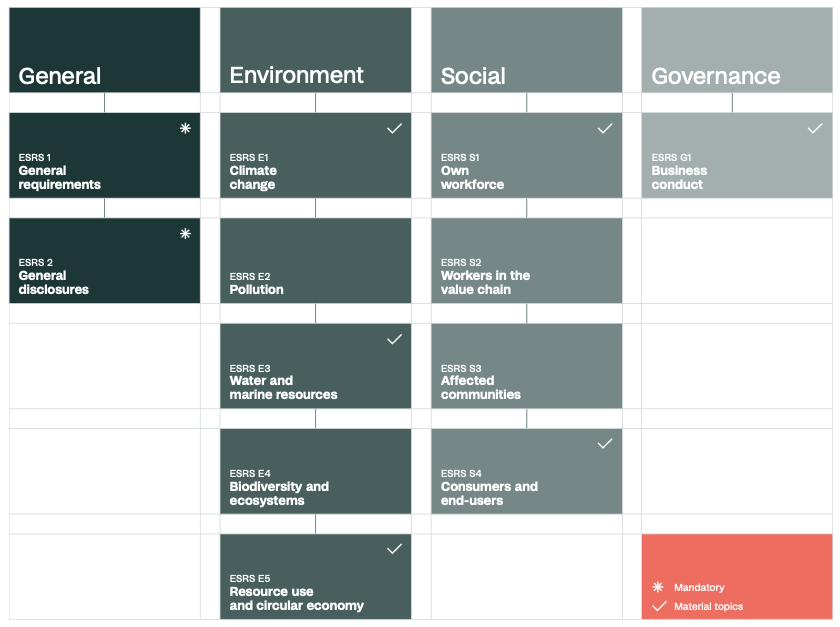
Netcompany
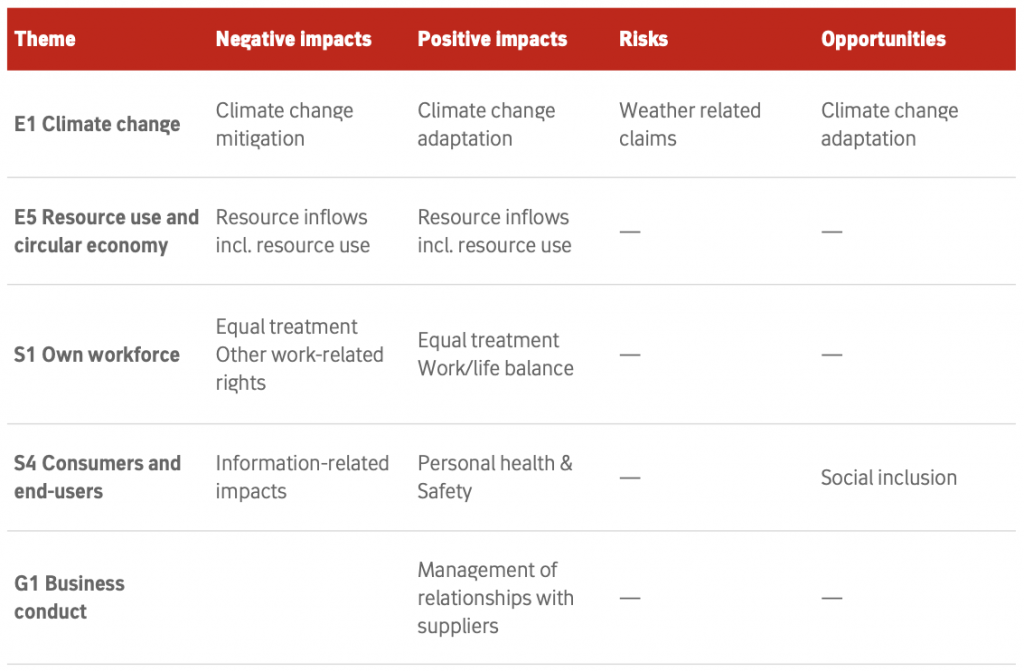
Tryg
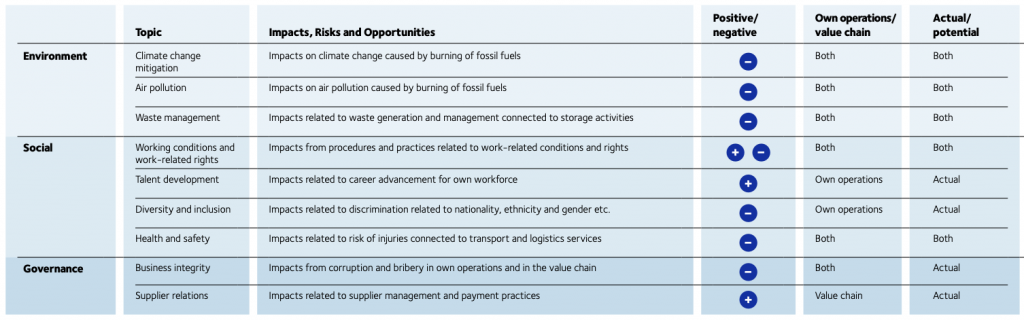
DSV
Stakeholder involvement:
- Netcompany: Stakeholder involvement is limited and documented in less detail. The focus is primarily on internal stakeholders and less on external partners or the value chain.
- Tryg: Strong involvement of external stakeholders such as customers, employees and social actors, especially in the case of climate-related risks. For example, cooperation with partners such as environmental organizations to develop climate adaptation for customers.
- DSV: Very intensive stakeholder involvement along the entire supply chain.
Other reporting standards: The DSV report also refers to the requirements of the Sustainability Accounting Standards Board (SASB) and mentions that the climate targets were set in line with the Science-Based Targets Initiative (SBTi). Tryg has also taken the SBTi guidelines into account when setting its targets and refers to the Global Reporting Initiative (GRI) on the subject of taxes. However, all three companies show the data points from other regulations (SFRD, Pillar 3, the Benchmark Regulation and the EU Climate Law) in a clear table.
Sustainable Development Goals (SDG): DSV refers to the UN sustainability goals it is pursuing in the report for each of the ESG topics. Tryg mentions the term SDG more generally, while Netcompany does not mention it at all.
Conclusion: What you can learn from the CSRD report list
The analysis of the first sustainability report examples in accordance with the CSRD and ESRS guidelines clearly shows how differently companies deal with the new requirements and how they set their individual priorities. Despite common principles such as the double materiality assessment and consideration of the EU taxonomy, there are considerable differences in methodology, reporting and strategic focus.
- Flexibility: There is no "one size fits all" approach. Consider your resources, objectives and stakeholder requirements to develop the reporting strategy that fits your company.
- Industry-specific: Design your reporting to reflect the specific risks and opportunities of your industry, making it more authentic and relevant. Use the CSRD report list to find the latest sustainability reports for your industry.
- Materiality assessment: The double materiality assessment should not only be seen as a reporting requirement, but also as a strategic tool to secure long-term competitive advantages.
- Stakeholders: The consideration of stakeholder perspectives (e.g. customers, employees, NGOs) should be an integral part of the reporting process in order to identify relevant topics and create trust.
- Software and tools: Digital CSR tools and CSRD software solutions can significantly simplify and accelerate the collection, analysis and reporting of data.
- Communication: Invest in clear and visually appealing reports to attract the attention of stakeholders and present complex content in an understandable way.
The first reports are an important milestone in establishing the new sustainability reporting standards. Companies that structure their reporting at an early stage and rely on a clear methodology are better prepared for future challenges. CSRD requires compliance and also offers the opportunity to drive forward sustainability strategies in a targeted manner and create long-term competitive advantages.
Flexible Excel template for carrying out the double materiality assessment. Analyze your material topics and document your findings in a structured way.
Frequently asked questions about the CSRD report list
Where can I find the CSRD report list?
The list is maintained by the University of Cologne, Goethe University Frankfurt and LMU Munich. You can access it directly via Google Sheets and also add new reports yourself. The link is in the introduction above.
What can I learn from other companies' CSRD reports?
Published reports show you how other companies structure their double materiality assessment, which topics they classify as material, how they present IROs and how they integrate the EU taxonomy. They are a practical reference when building your own report.
Do all CSRD reports look the same?
No. While common elements appear in all analyzed reports (double materiality, EU taxonomy, E1 climate change, G1 business conduct), the methodology, depth of stakeholder engagement and presentation differ significantly. There is no single prescribed format.
Is a traditional materiality matrix required in a CSRD report?
No. None of the three companies analyzed include the traditional materiality matrix. The ESRS focus is on systematic IRO identification and double materiality, not on the visual matrix format familiar from older GRI-based reporting.
Word template (and PDF) for a sustainability report according to the ESRS VSME standard. Ready to use and structured for your first CSRD-aligned report.