Sustainability Transformation Monitor 2026: What the study means for SMEs
Sustainability Transformation Monitor: 83% of companies see no business case for sustainability, yet SMEs should still act.
- The Sustainability Transformation Monitor 2026 surveyed 822 organizations in Germany and finds structures in place but momentum fading.
- 83% of companies still see no viable business case for sustainability, yet 75% plan to keep reporting voluntarily even after losing their CSRD obligation.
- The VSME standard (being broadened into the "VS - Voluntary Standard" in 2026) is the pragmatic entry point for SMEs.
- Large customers will still need supply-chain ESG data despite the Value Chain Cap, so smaller companies that invest now protect key relationships.
- ESG managers and consultants who build the internal business case proactively will gain a lasting competitive edge over those who wait.
Bertelsmann Stiftung, together with Stiftung Mercator, the University of Hamburg and the Peer School for Sustainable Development, has published the Sustainability Transformation Monitor 2026 (STM26). The study is one of the most comprehensive assessments of the sustainability transformation in Germany. Based on a survey of 822 organizations from the real economy and the financial sector, the study paints a nuanced picture: the structures are in place, but momentum is fading.
In this article, we put the key findings into context for ESG managers and consultancies and derive concrete next steps, especially for small and medium-sized enterprises (SMEs).
The 6 key takeaways from the Sustainability Transformation Monitor
1. From new beginnings to consolidation
Sustainability is structurally embedded in many companies: around 70% have placed responsibility at board or executive management level. Sustainability management has become standard practice. However, STM26 shows a clear slowdown: the share of companies actively planning a strategic approach has fallen by around ten percentage points. That is not entirely negative. Six of those ten points are companies that have since implemented their plans. But four percentage points are companies that have put their plans on hold.
Momentum is still strongest in the mid-market. If you build structures now, you will be among the frontrunners, not the laggards.
2. More climate data, but transition plans are stagnating
86% of the surveyed companies and banks now record their greenhouse gas emissions at least in part. The scope of data collection is growing; large companies in particular are increasingly including upstream and downstream stages of the value chain. 59% of companies have set climate targets. Among banks, this share has even risen from 46% to 65%.
The problem: concrete plans for how these targets will be achieved are stagnating. Around 41% of companies are still "in planning." And biodiversity remains a niche topic. Only a few companies address it in any substantive way.
3. Sustainability is losing internal priority
This may be the study's most alarming finding: for 59% of companies, current social and political debates are causing sustainability to lose importance internally. The drivers are shifting dramatically:
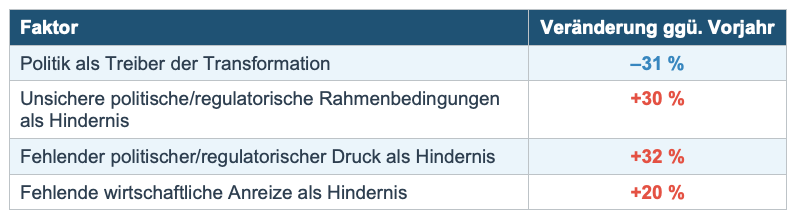
Especially relevant: 83% of companies still see no viable business case for sustainability. While 43% recognize financial added value, they believe it still falls short of the associated costs.
4. Banks as transformation partners, but relevance is declining
Sustainability still plays a secondary role as a catalyst in financing practice: only 30% of companies and 37% of banks rate sustainability as important in their joint discussions, and the trend is downward in both groups. All surveyed major banks already see themselves as transformation partners, but around two thirds of mid-sized and smaller institutions are still building their capabilities.
5. Willingness to report remains high, even without an obligation
Despite the omnibus procedure and the uncertainty associated with it, a surprisingly clear picture emerges:
- 75% of companies that will no longer fall under the CSRD in the future want to continue reporting voluntarily.
- 59% of companies that will be subject to reporting requirements from 2027 already feel well or very well prepared for the CSRD.
- The VSME standard is gaining significant importance among companies with up to 1,000 employees and is rated mostly positive in terms of cost-benefit.
- 55% of companies that want to report under VSME already feel well positioned to do so. There are also practical aids, such as the VSME reporting template or the VSME data point list.
Most companies have understood that sustainability reporting is not a temporary trend. Those who have built structures want to use them, regardless of legal requirements.
6. Sustainability has arrived in investment practice
Almost all surveyed investors (96%) pursue overarching approaches to responsible investing, and 93% have formal exclusion policies. 74% explicitly market their products as ESG-compliant. The EU Taxonomy and the SDGs serve as the primary reference frameworks. However, strategic depth varies considerably, especially in stewardship activities and proxy voting policies.
What does this mean in concrete terms for SMEs?
At first glance, the Sustainability Transformation Monitor may seem primarily relevant to large companies. But the implications for small and medium-sized enterprises are significant for three reasons.
The trickle-down effect remains
Even if the CSRD obligation no longer applies to many companies, large companies that are required to report still need data from their supply chain. The new Value Chain Cap does limit what they are allowed to request from partners with 1,000 employees or fewer, but it does not eliminate requests altogether. SMEs that cannot provide ESG data risk losing important customer relationships in the medium term.
VSME as an opportunity, not a burden
The VSME standard is becoming the pragmatic entry point for SMEs. Note that VSME is being broadened into the "VS (Voluntary Standard)" later in 2026, making it relevant not just for SMEs but for any company outside the CSRD scope with fewer than 1,000 employees or under 450 million euros turnover. The data from STM26 confirms its appeal: most companies with up to 1,000 employees rate the cost-benefit ratio positively. At the same time, VSME serves as a kind of shield: those who report under VSME can push back against excessive ESG questionnaires from large customers.
The business case must be made internally
83% still see no viable business case. On one hand, that reflects reality. On the other, it is a matter of perspective. STM26 explicitly recommends linking sustainability to cost reduction, risk management, supply chain stability and access to capital. This is exactly where ESG managers come in: build the business case proactively instead of waiting for external triggers.
7 concrete action steps for ESG owners
Based on the Sustainability Transformation Monitor findings and the study's recommendations, we suggest the following steps.
1. Assess the status quo honestly
Before taking action, you need clarity. Where does the company stand compared to industry benchmarks? Use the study as a mirror:
| Question | Benchmark |
|---|---|
| Is sustainability anchored at managing director or board level? | 70% |
| Do you record greenhouse gas emissions? | 86% |
| Have you set climate targets? | 59% |
| Is there a concrete transition plan? | only 41% "in planning" |
2. Use VSME as your entry point
For SMEs that do not fall directly under the CSRD, the VSME standard (soon to be renamed VS) is the ideal starting point. It consists of two modules:
- Basic Module: 11 disclosure requirements on GHG emissions (Scope 1 and 2), environmental metrics, own workforce and anti-corruption. The right entry point for most SMEs.
- Comprehensive Module: 9 additional requirements including GHG reduction targets, transition plans and value chain incidents. Useful if you want to make full use of the Value Chain Cap protection.
3. Capture climate data systematically
86% of companies already do this, at least in part. If you have not started yet, start now:
- Scope 1: Direct emissions from your own facilities and vehicles. Often quick to capture.
- Scope 2: Indirect emissions from purchased energy. Can be derived from electricity bills.
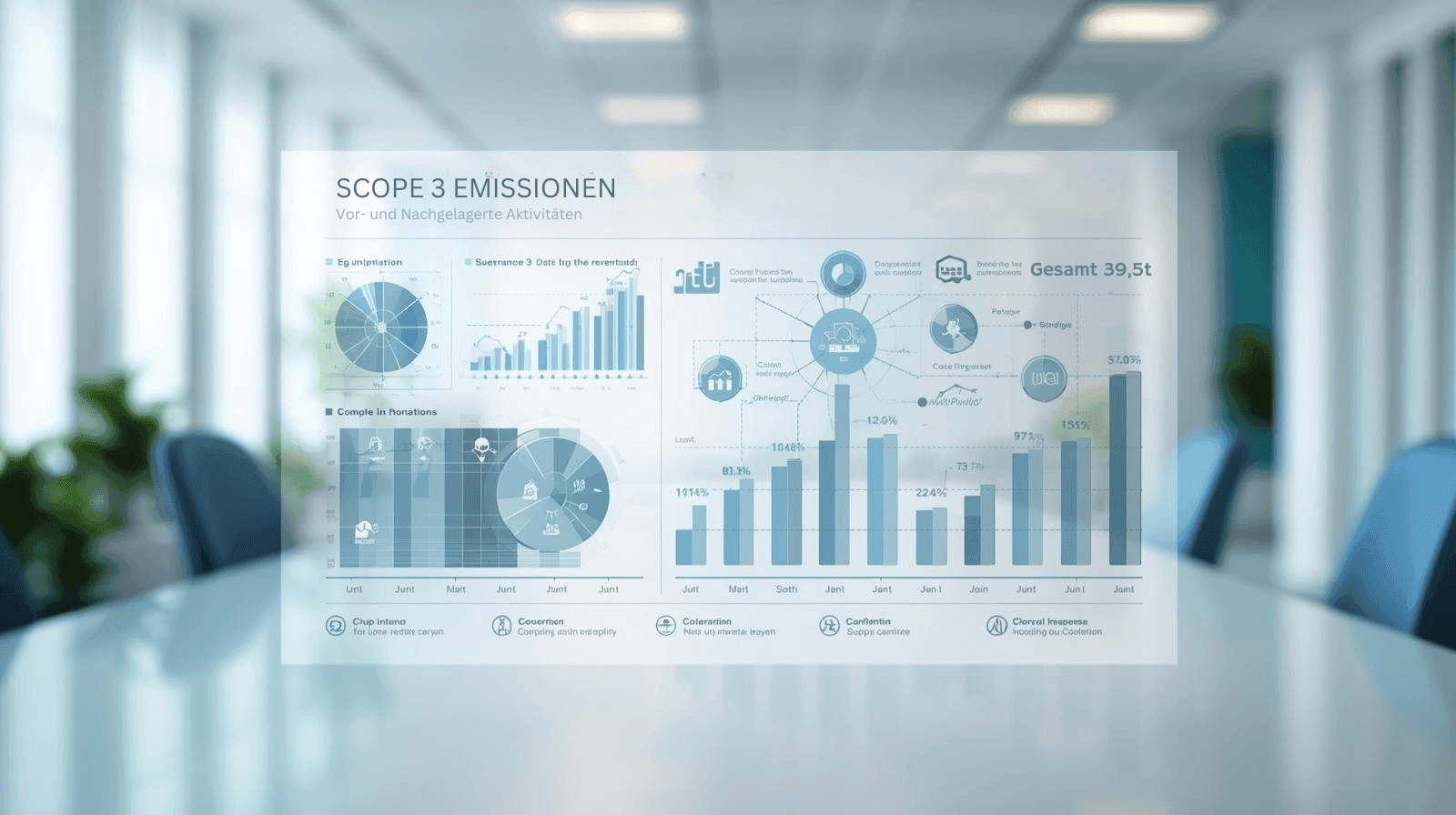
- Scope 3: Upstream and downstream emissions. Complex, but increasingly required. Start with the most material categories.
Digital tools such as CO2 calculators can make getting started much easier. Data quality does not have to be perfect in the first year. What matters is establishing the process.
4. Build the internal business case
83% see no business case? Then build it yourself. STM26 recommends systematically linking sustainability to:
- Cost reduction: Energy efficiency, material reduction, waste avoidance
- Risk management: Climate risks, supply chain risks, regulatory risks
- Access to capital: Better financing terms through structured ESG data
- Market opportunities: Customer retention, public procurement, new business areas
Create a simple overview: What does sustainability currently cost? What does it save or generate? Qualitative effects such as reputation and employee retention belong here too. Financial opportunities and risks can also be identified by conducting the double materiality assessment.
5. Integrate ESG data into decisions
The study shows that many companies already collect data but do not use it for operational decisions. The STM26 authors are clear: consistently incorporate existing climate, resource and supply chain data into management, investment, procurement and product development decisions. Feed your GHG inventory into your next investment decision. Make ESG criteria part of your supplier evaluation. Use sustainability data in your next bank meeting.
6. Actively shape the dialogue with financing partners
STM26 shows that the relevance of sustainability in financing discussions is declining, but at the same time 79% of banks expect ESG to become more important in the future. SMEs that bring their sustainability data, target pathways and investment plans into the dialogue with banks early and in a structured way can secure better terms and greater planning certainty.
7. Leverage partnerships
The study explicitly recommends tackling transformation challenges together, through industry solutions, supply chain collaborations and regional networks. Especially where resources are scarce, collaboration is the most efficient path. Join regional sustainability networks, use Chamber of Commerce offerings, and exchange experiences with other SMEs in your industry.
Checklist: Your next steps
Based on STM26, these no-regret measures make sense regardless of further regulatory developments:
- Anchor sustainability at managing director or board level and clearly define responsibilities
- Systematically record GHG emissions (at least Scope 1 and 2)
- Review the VSME standard and evaluate it as a reporting framework
- Build an internal business case with concrete figures
- Integrate ESG data into operational decisions (procurement, investments, product development)
- Prepare sustainability data for bank meetings and financing rounds
- Set climate targets and outline initial steps for a transition plan
- Use regional networks and industry collaborations for joint solutions
- Prepare for excessive ESG questionnaires: know the Value Chain Cap and VSME as a shield
Ready to start your sustainability report? Our VSME Word template guides you through all disclosure requirements step by step, saving you hours of formatting and structuring work.
Conclusion on the Sustainability Transformation Monitor
The Sustainability Transformation Monitor 2026 paints a paradoxical picture: the institutional foundations are in place, data quality is steadily improving, but momentum is fading. Political uncertainty, a lack of economic incentives and a business case that is often still hard to pin down are slowing progress.
For ESG managers and consultants, this is exactly where the opportunity lies: those who keep investing now while others wait will gain a lasting advantage. Most companies are staying the course. 75% want to continue reporting voluntarily, VSME offers SMEs a pragmatic entry point, and the data foundation keeps getting better.
The STM26 authors put it succinctly: what is needed now is less fragmentation, more strategic prioritization, stable framework conditions and economic levers that make sustainability effective again as an investment and competitiveness factor. And that starts in every single company.
Frequently asked questions about the Sustainability Transformation Monitor 2026
What is the Sustainability Transformation Monitor 2026?
The STM26 is a large-scale study by Bertelsmann Stiftung, Stiftung Mercator, the University of Hamburg and the Peer School for Sustainable Development. It surveyed 822 organizations from the German real economy and financial sector to assess the state of sustainability transformation. Key findings: structures are in place, 86% of companies record emissions, but momentum is slowing and 83% still see no clear business case for sustainability.
Does the VSME standard apply to my company even if I am not CSRD-obligated?
Yes. VSME was designed precisely for companies outside the mandatory CSRD scope. Under the updated rules (in force since 18 March 2026), only companies with more than 1,000 employees and more than 450 million euros turnover are CSRD-obligated. All others can use VSME, which is being broadened into the "VS (Voluntary Standard)" later in 2026. It covers the most important ESG topics and also protects you against excessive data requests from large customers via the Value Chain Cap.
How do I build an internal business case for sustainability?
Start with what is measurable: energy costs, waste, material consumption. Then add risk factors such as climate risks (extreme weather, stranded assets) and supply chain dependencies. Finally, include qualitative benefits: customer retention, employee attraction, access to green finance. The STM26 authors recommend linking sustainability explicitly to cost reduction, risk management, supply chain stability and capital access. A climate risk analysis template can help structure the risk side.
What is the Value Chain Cap and how does it protect SMEs?
The Value Chain Cap limits what CSRD-obligated large companies may demand from their supply-chain partners. Companies with 1,000 employees or fewer cannot be required to provide information beyond the voluntary standard (VSME or VS). This cap is an important protection for SMEs, but the practical expectation to share some ESG data remains. Reporting proactively under VSME puts you in a stronger negotiating position.